November 8, 2026
Inside vs. outside mount shutters: which is right for your windows?
By Dave Harris — Co-founder, Golden West Shutters
Neither is always better. Inside mount sits within the window opening and looks built-in, but the frame shrinks the opening, so you get shorter louvers and less glass. Outside mount sits around the opening and keeps full-length louvers, more light and more view. Your window depth, your trim and the look you want decide it.
Mount style is one of the most important design choices on a plantation shutter, and one of the least explained. Dave and John, the owners of Golden West Shutters, walk through it with every homeowner at the consultation, window by window. This guide covers the same ground.
What is the difference between inside and outside mount shutters?
An inside mount fastens the shutter frame inside the window opening. The panels open and close within the opening, and the shutter reads as part of the window.
An outside mount, also called a surface mount, fastens the frame around the opening, on the casing or the wall. The panels cover the whole window, so nothing inside the opening is lost to the frame. It frames the window and can make it look larger.
| Inside mount | Outside mount | |
|---|---|---|
| Where the frame goes | Inside the window opening | Around the opening, on the casing or wall |
| Look | Clean, built-in, low profile | Frames the window, can make it look larger |
| Louvers | Up to 15% shorter, a panel can lose one or two | Full length |
| Cleaning the window | Frame on the sill, top and sides gets in the way | Open the panel and the window is clear |
| Removing windows and screens | The frame can block them | Opening stays clear |
| Matching top rails across windows | Rail sizes set by each opening, harder to line up | Easy to line up across the room |
| Replacing windows later | Frame is on the jamb and hard to remove without damage | No issue, the frame is on the wall |
| Best when | The opening is deep enough and square | Frames are shallow or uneven, or you want the full view |
The two kinds of inside mount
Inside mounts come in two types, a flush L-frame and a Z-frame. Both use a 1¼-inch jamb inside the window opening, and both shrink the window. The flush L-frame leaves existing casing untouched. The Z-frame wraps 1 to 3 inches onto the wall and gives a drywall-wrapped window a casing look. Read the flush L-frame vs. Z-frame guide.
Is your window deep enough for an inside mount?
The simple rule: 2½-inch louvers need 2 inches of depth, 3½-inch louvers need 2½ inches, and 4½-inch louvers need 3 inches, about ¼ inch more with a hidden tilt. Locks and crank handles matter too, not just depth. See the depth chart and hardware fixes.
Why does an inside mount shrink your window?
Every inside mount puts frame inside the opening, so the panels have to fit within what is left. The louvers can be up to 15% shorter, and a panel can lose one or two louvers. That means less glass, less light and less view when the shutters are open.
Why do some shutter companies recommend inside mounts?
Mostly because of the material. Many shutter sellers buy poly or composite shutters from an outside factory. Heavy materials need a thick L-frame for support, and a thick, boxy frame mounted on the wall is not attractive. Mounting it inside the window hides it.
An inside mount also shrinks the window, and a smaller shutter costs less to buy. For a broker who resells shutters, making the order smaller is a way to save money on every job, while you end up with less glass, light and view.
A custom manufacturer can build any mount, so the recommendation can follow the window. Golden West has no stake in which mount you choose. We build all three, flush L-frame, Z-frame and outside mount, show you each one at your window and let you decide. That is part of the design work, and the choice is yours.
When a window does need an L-frame, we size it to suit. Our L-frames run from 1½ to 2½ inches, depending on the window and what you want, because every frame is made in our Lake Forest factory. A shutter bought through a dealer usually comes with one L-frame size for every window. Wood and Polylux are light and strong enough for a slim frame, so we only add a heavier frame when the window requires it.
When is outside mount the better choice?
Dave prefers outside mount on narrow and short windows, where an inside mount frame takes the biggest share of the glass. His rule of thumb: an inside mount costs you one louver, maybe two. Outside frames come in widths from 1 to 3 inches, including a 2-inch taper that slopes to only ⅝ inch at the edge. Compare outside mount frame styles and sizes.
Cleaning, screens and window replacement
An inside mount puts frame on the sill, top and sides of the window, which can block windows and screens that come out for cleaning. It is also hard to remove without damage if you replace your windows later. An outside mount avoids both. Read how each mount affects cleaning, screens and replacement.
Can I mix inside and outside mounts in one home?
Yes, and most homes should. When Dave walks into a living room with large windows and handsome decorative casing, he knows it will likely be a flush mount or a 1-inch Z-frame. In a family room or upstairs bedroom with no casing, the criteria change. Each room, and each window, gets its own answer.
Shutters on doors
Shutters on French doors and patio doors are outside mount about 95% of the time. When a window sits right next to a door, Dave makes the frames the same height. With an outside mount, he can adjust the window shutter's height and keep the rails lined up with the door, so the wall reads as one continuous look.
Doors usually have casing around them. When a window is close to a door, Dave aligns the window shutter to the top of the door casing, so the eye doesn't catch two different heights. A fixed Z-frame on drywall, or an outside mount that doesn't line up with the door casing, looks unplanned. The eye picks up any line that wasn't thought out, and an outside mount gives the flexibility to get it right.
Because we build every frame ourselves, we can often make a molding that closely matches the casing around a door. Shutters bought through a dealer usually come with only a few standard frame options.
Yes. At Golden West, inside and outside mounts cost the same, so you can choose the mount that suits each window rather than the one that fits a budget.
Which mount fits which window?
| Your window | Usually the best fit |
|---|---|
| Square, and deep enough for your louver size | Flush inside mount |
| Has casing you want to leave untouched | Flush inside mount with an L-frame |
| Drywall-wrapped, no casing, and you want a trim look | Inside mount with a Z-frame |
| You want an inside mount, but the window is shallow or out of square | Inside mount with a 1-inch Z-frame |
| Very shallow frame, or you want the most light and view | Outside mount |
| You may replace the windows in the next few years | Outside mount |
| A room with windows of different heights | Outside mount, with matching top rails |
| Large windows with decorative casing | Flush mount or 1-inch Z-frame |
| A window next to a door | Outside mount, lined up with the door casing |
| Windows or screens you take out from inside to clean | Outside mount |
Most homes end up with a mix. A dining room with casing may suit a flush mount, while a drywall-wrapped family room window suits a Z-frame or outside mount. We measure every opening and recommend a mount for each one, not one rule for the whole house.
Will the salesperson explain inside vs. outside mount?
Often not. At a distributor or broker, the salesperson's job is to sell the shutters, not to walk through the pros and cons of each mount. A remeasure person usually comes out later, and their role is to confirm sizes, not to go over options unless there is a problem.
At Golden West, the owners design every job. Dave and John are both engineers and have worked through these window challenges thousands of times since 1987. They know the tools, the frame modifications and the details covered in this guide. If you are leaning toward inside mounts, especially on custom windows rather than standard vinyl, who sells and designs your shutters matters even more.
Why does design matter more in custom, architectural homes?
Custom windows, special locks, cranks and screens raise the stakes. Dave often walks into a highly detailed, architectural home with a big investment in its windows and thinks, this is a tricky design. It is not just a matter of measuring. The homeowner is relying on the salesperson, the installer or the shutter company to have thought it through.
On jobs like that, Dave looks carefully at the complexity and the risk before recommending anything, and he will tell a homeowner when an approach is not recommended. "Any headache they have, I have," he says. "It's kind of like a chess game. I tell them, if I do it this way, this is what you're going to get. I'm risk-averse."
See both mounts at our Lake Forest showroom
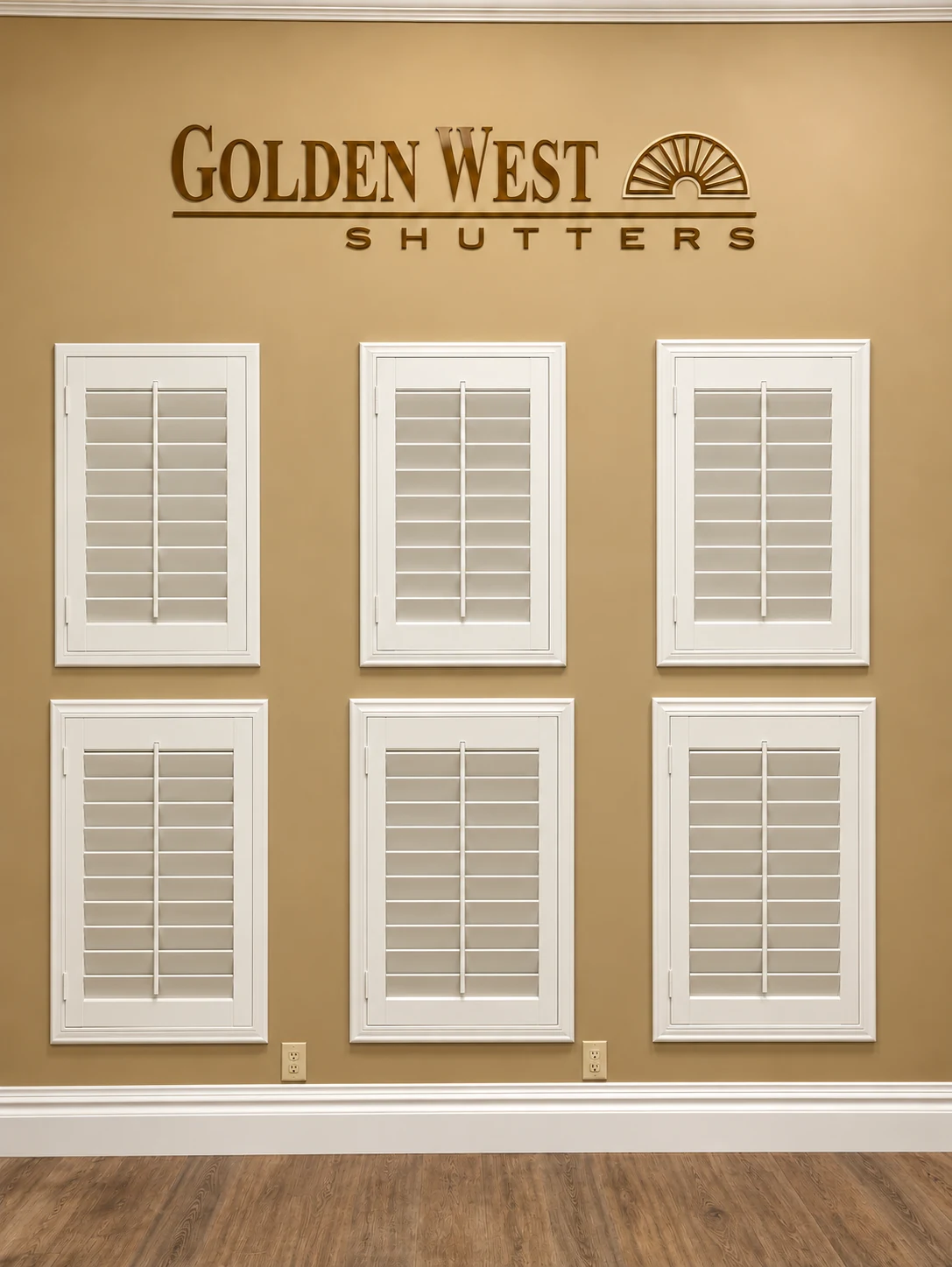
Our showroom has the same window size mounted both ways, inside mount above outside mount, so you can see the difference in louver length and light for yourself. Dave also keeps flush L-frame and 1-inch Z-frame samples to show at your window. Visit our factory and showroom in Lake Forest, see how we design custom plantation shutters, or call 949-951-0600 for a free in-home consultation.

